What NE Pad Adhesion Testing Covers
IEC 60601-2-2 adhesion testing is not just a single adhesive-strength test. It includes three evaluations that cover different conditions an NE pad might face during use.
The testing evaluates whether the pad:
• Remains attached when force is applied to its cord
• Conforms to curved areas of the patient’s body
• Maintains adhesion after direct exposure to fluid
These tests are made to check the adhesion of electrosurgical neutral electrodes according to IEC 60601-2-2. They do not apply to devices outside this standard, like ECG electrodes, wearable sensors, or other adhesive-backed medical devices not covered by IEC 60601-2-2.
Pull Test
The pull test assesses whether the NE pad remains attached when the cord is pulled in different directions.
At least two NE pad samples are applied to each of:
• At least 10 male participants
• At least 10 female participants
• A minimum of 40 test samples
The pads are applied according to the manufacturer’s instructions for use and left undisturbed for the prescribed period.
For NE pads intended for adult patients, a 10 N force is applied at the pad’s cord connection point:
• For 10 minutes in one direction
• For 10 minutes in a second, perpendicular direction
• With both forces applied in a plane parallel to the skin
Pull-Test Acceptance Criterion
No more than 5% of the NE adhesive area may separate from the skin in at least 90% of the tests.
Conformability Test
The conformability test evaluates whether the NE pad remains adequately attached when applied to a curved body surface, such as an arm or leg.
NE pads are applied to approximately cylindrical locations on at least:
• Five male participants
• Five female participants
The circumference of the application site must be between 1.0 and 1.25 times the length of the NE pad’s major axis. The pad is applied with its major axis encircling the selected site.
After one hour, the pad is photographed and the amount of adhesive separation is measured.
Conformability Acceptance Criterion
No more than 10% of the NE adhesive area may separate from the skin.
The conformability test is not required when this type of application site is contraindicated in the manufacturer’s instructions for use.
Fluid Tolerance Test
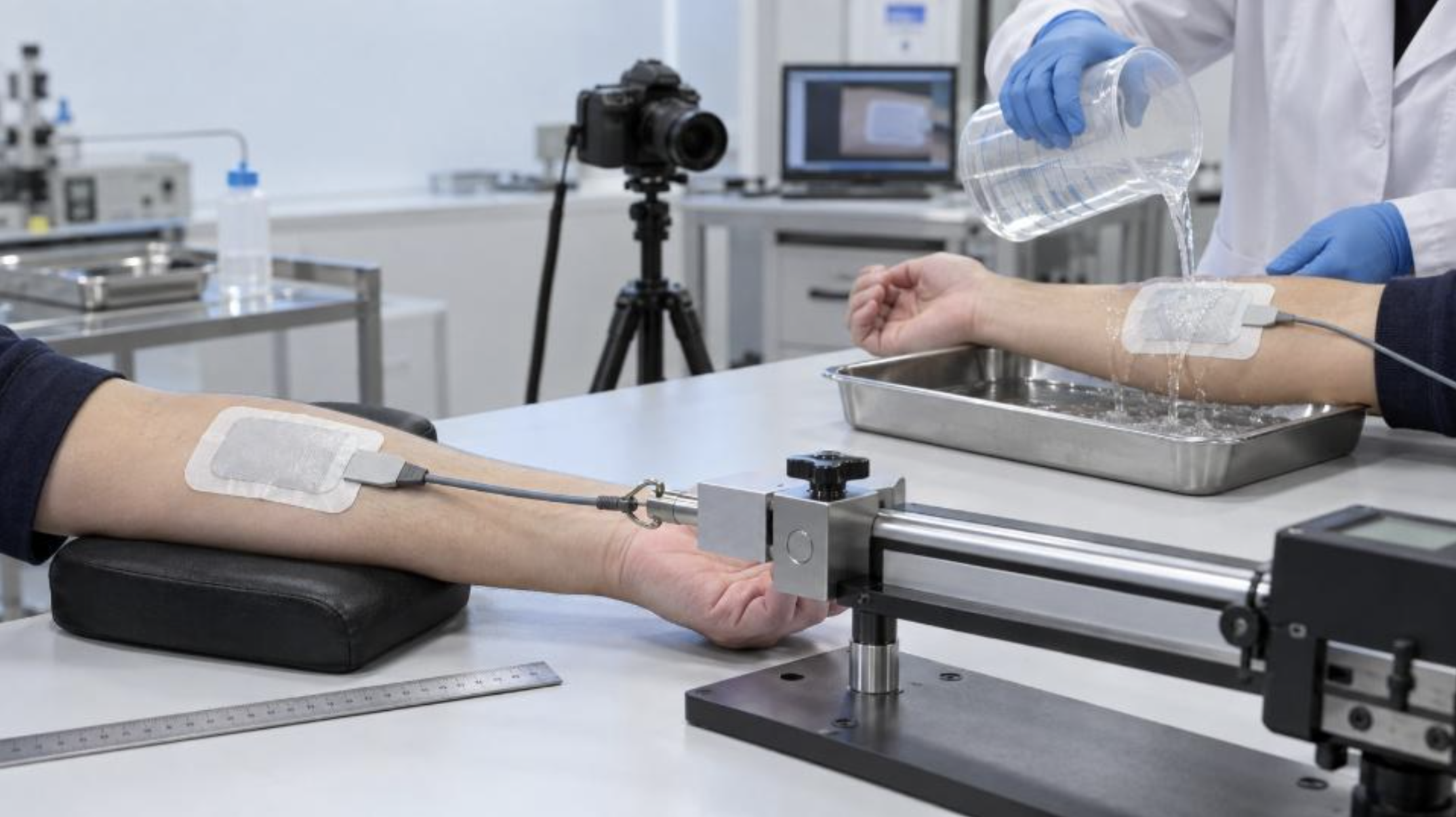
The fluid tolerance test, sometimes called the water test, checks if the NE pad stays attached after direct exposure to fluid.
NE pads are applied according to the manufacturer’s instructions for use to at least:
• Five male participants
• Five female participants
One liter of 0.9% saline is poured directly over the NE pad:
• From a height of 300 mm
• Over a period of 5 to 15 seconds
The pad remains in place and is evaluated 15 minutes after the saline exposure.
Fluid-Tolerance Acceptance Criterion
No more than 10% of the NE adhesive area may separate from the skin within 15 minutes after the saline is poured.
Human-Participant Testing
All three evaluations are performed with the NE pads applied to human skin.
Before testing, participants are screened for conditions that could make participation inappropriate, such as skin conditions, adhesive sensitivities, or other issues affecting the intended application site.
The application sites are prepared according to the manufacturer’s instructions for use. Applicable measurements, environmental conditions, sample identifications, observations, photographs, and results are documented.
No electrosurgical output is applied to the participant during these adhesion tests.
Sample Requirements
For one NE pad configuration, a complete three-test program will ordinarily require at least:
• 40 samples for the pull test
• 10 samples for the conformability test
• 10 samples for the fluid tolerance test
• At least 60 test samples in total
It is recommended to have extra samples in case a pad is damaged, contaminated, applied incorrectly, or not suitable for testing.
The final sample quantity may vary based on the following:
• The number of models or configurations
• Pad dimensions
• Adult or pediatric intended use
• Cord and connector configurations
• Instructions for use
• Whether the conformability test applies
F2 Labs will confirm how many samples are needed before testing starts.
What the Test Report Includes
The F2 Labs report documents:
• Product and sample identification
• Applicable models and configurations
• Instructions used to prepare and apply the pads
• Participant and application-site information
• Required test conditions
• Applied forces, times, and measurements
• Percentage of adhesive separation
• Photographs and observations
• Pass/fail results for each applicable test
You can include the report in your product’s compliance documentation.
What This Testing Does Not Cover
This service addresses the adhesion requirements in IEC 60601-2-2, Clause 201.15.101.7.
Other IEC 60601-2-2 requirements may separately evaluate:
• Contact quality monitoring compatibility
• Current distribution
• Thermal performance
• High-frequency electrical performance
• Other construction or marking requirements
These evaluations are not included by default in an adhesion-only test program.
Why Medical-Device Teams Choose F2 Labs
F2 Labs knows that NE pad adhesion testing is part of a full electrosurgical safety evaluation, not just a basic adhesive-strength test.
We provide:
• Experience with IEC 60601-2-2 neutral electrode requirements
• Coordination of the required human participants
• Review of pad configurations and instructions for use
• Defined sample requirements before testing begins
• Clearly documented test setups, measurements, photographs, and results
• Straightforward communication throughout the project
• Test reports prepared for use in compliance documentation
What Information Does F2 Labs Need to Prepare a Quote?
Please provide:
• NE pad model or model family
• Available sizes and configurations
• Instructions for use
• Application and skin-preparation instructions
• Intended patient population
• Cord and connector information
• Sample aging status, if applicable
• Desired testing timeline
Our team will review the information and confirm the applicable tests and sample quantity.
Ready to Start?
Test your NE pad’s adhesion under mechanical pull, curved-body placement, and fluid exposure before it causes any certification delays.
Contact F2 Labs to talk about your product configurations, sample needs, and project timeline.
Ready to Start?
Test your NE pad’s adhesion under mechanical pull, curved-body placement, and fluid exposure before it causes any certification delays.
Contact F2 Labs to talk about your product configurations, sample needs, and project timeline. Contact F2 Labs to talk about your product configurations, sample needs, and project timeline.
Helpful Links:
FAQs
What is an NE pad?
An NE pad is a patient-applied neutral electrode used during monopolar electrosurgery to provide a return path for high-frequency current. It may also be called a return electrode, a dispersive electrode, a patient plate, or a grounding pad.
What are the three NE pad adhesion tests?
Clause 201.15.101.7 includes a pull test, a conformability test, and a fluid tolerance test. Each addresses a different potential cause of adhesive separation: force applied to the cord, placement on a curved body surface, and exposure to fluid.
Is the fluid tolerance test performed with water?
The test method of the standard requires one liter of 0.9% saline—not ordinary tap water. The saline is poured directly over the applied NE pad under specified conditions.
Is the conformability test always required?
Not necessarily. The conformability test is not required when application to the specified type of curved or cylindrical body site is contraindicated in the product’s instructions for use.
Is electrical energy applied during testing?
No. The NE pad is not energized, and electrosurgical output is not applied to the participant during the pull, conformability, or fluid tolerance tests.
Does this testing evaluate electrical or thermal performance?
No. These tests evaluate adhesion to the skin. Monitoring of electrical performance, current distribution, temperature, and contact quality is addressed in separate IEC 60601-2-2 requirements.
Can this testing support shelf-life validation?
Yes. Testing may be performed on aged NE pad samples as part of the manufacturer’s shelf-life validation plan. The appropriate aging condition and validation strategy are established by the manufacturer.