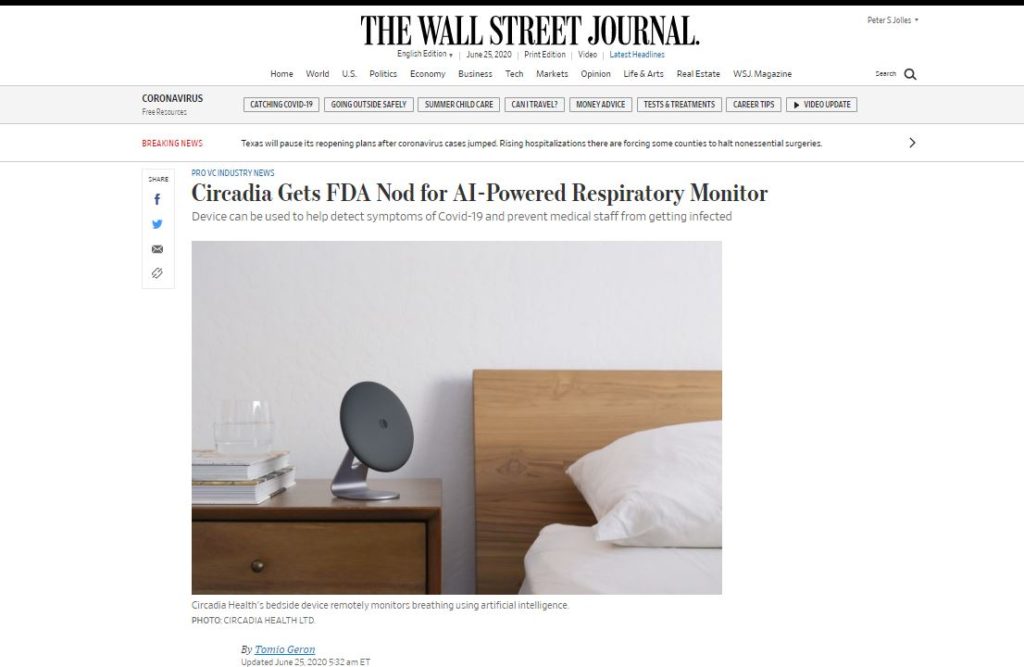
The Circadia C100 Remote Bedside Monitor paired with the Circadia Pro App helps nurses monitor multiple patients at one time.
It is safe to say that COVID-19 has affected everyone in the world. F2 Labs immediately joined the fight and offered pro-bono services to our customers who are working to alleviate the suffering caused by this terrible illness.
“It was the right thing to do and, I am so proud of everyone on our team who worked to get these evaluations completed quickly and correctly,” is how Wendy Fuster, President of F2 Labs, characterized the effort.
One of our customers, Circadia Health, worked with F2 Labs in pursuit of FDA 510(k) clearance on a bedside device for monitoring the breathing of people stricken with the disease and to help with early detection.
Our engineers knew that this wasn’t just a project: it was a way for us to “get in the fight.”
This device is so significant that it was featured in today’s Wall Street Journal.
The Circadia C100 was evaluated at F2 Labs EMC and Safety testing laboratories.
Understanding the requirements for compliance to RoHS 2011/65/EU is not difficult (and we can help you), but ignoring them can get your product stopped upon entry into the EU.
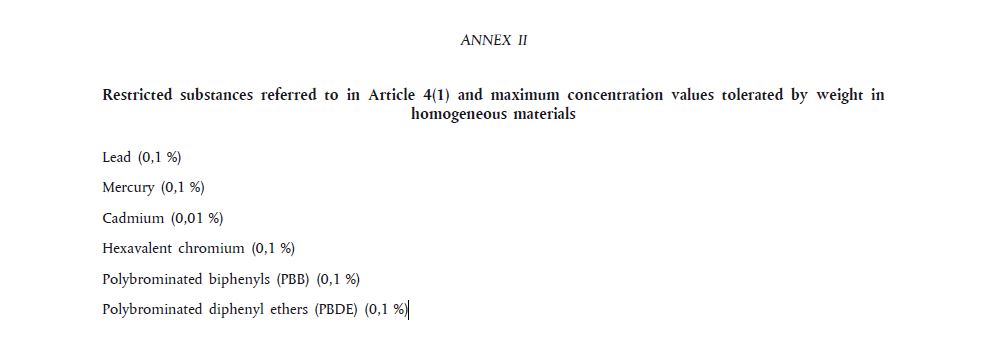
RoHS stands for the “restriction of hazardous substances”. Initially, it restricted four heavy metals and two flame retardants per Annex II.
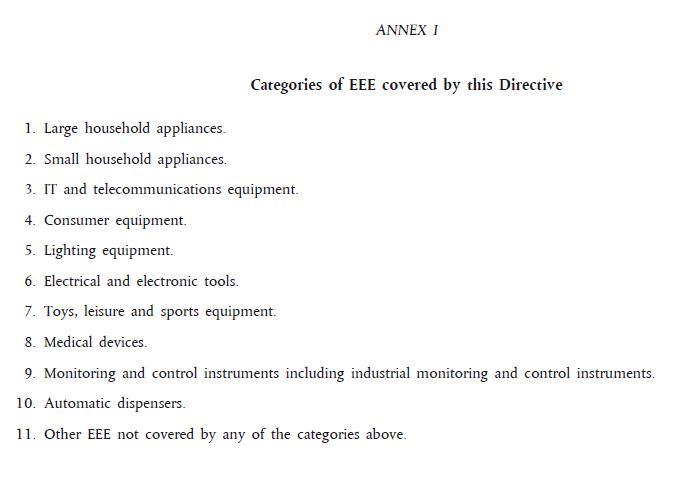
Compliance with the RoHS Directive 2011/65/EU is required for categories of electrical and electronic equipment which are indicated in Annex I.
The Annex II list is very comprehensive. Basically, any equipment that has any electric function is in the scope of this Directive. Equipment that is in the scope of RoHS must meet all of the substance restriction levels in Annex I. More specifically it means that every single part in your product (every pin, every resistor, every screw, even labels, and paint) must also individually meet those substance restriction levels. You cannot use a small part which is composed of 5% lead and compare that part in the context of the weight of the whole device. Each part must also be compliant.
The EU has published many amendments to the RoHS Directive. Most deal with very specific exemptions that are industry or application-specific. For instance – brass and other copper alloys can have a lead content of up to 4%. The EU publishes these in the Official Journal of the EU and also on a RoHS web page that is constantly updated. That page is here.
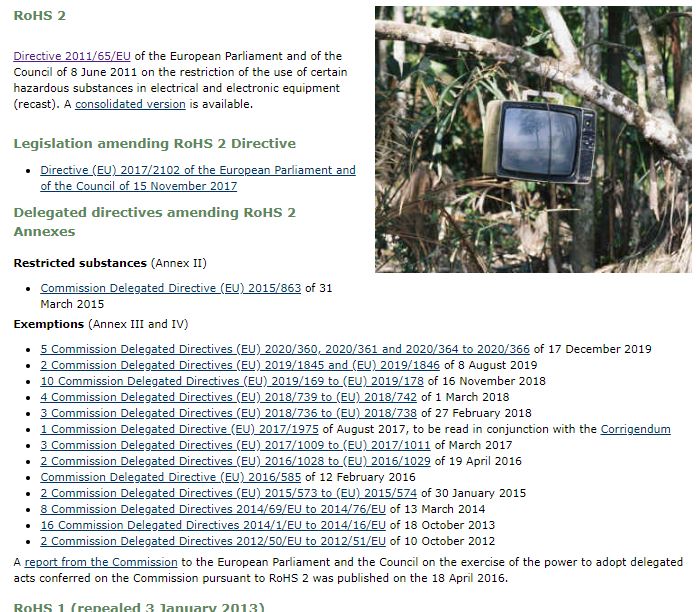
Below is a screenshot of the RoHS page with links to RoHS 2011/65/EU and all of the published amendments.
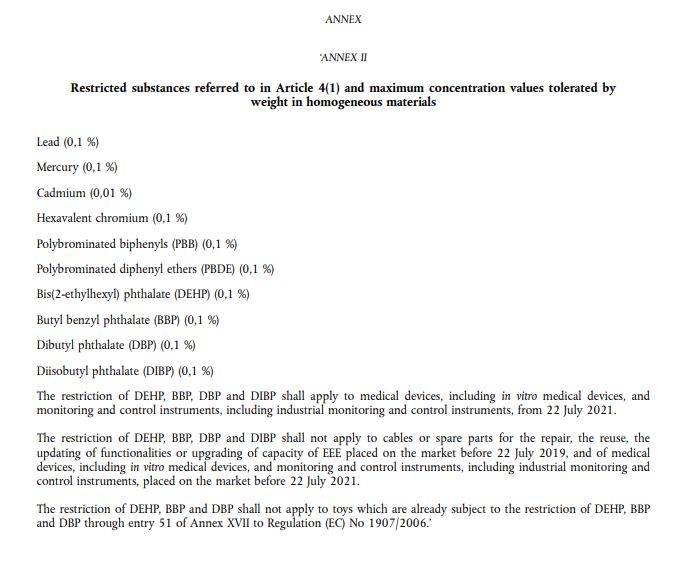
Notice that there are many, many amendments – but only (EU)2015/863 and (EU)2017/2102 are separated from the main list. (EU)2017/2102 is a short document that clarifies some language and addresses the use of spare parts and pipe organs (yes, pipe organs). (EU)2015/863 is much more important because it added four new substances to the Annex II list above: four phthalates. Phthalates, I have learned, are plasticizers that make plastic more pliable. Googling it, I came to a CDC fact sheet defining them in greater detail.
Therefore the importance of (EU)2015/863 is contained in the expansion of Annex II in RoHS 2011/65/EU. See below.
The last four substances are the “new” restricted phthalates. Now that I have laid the groundwork, we have arrived at the main purpose of this article:
Claiming compliance to RoHS 2011/65/EU encompasses a claim of compliance to (EU)2015/863 also as long as the original six-substance list is not referenced.
I wrote that in bold and italics because many times I see reference to “RoHS3” or “RoHS 2015/863.” Because of the confusion surrounding this, we write it as “RoHS 2011/65/EU + (EU)2015/863” on our proposals and much of our correspondence with our customers.
I have referenced the EU’s RAPEX weekly reports many times in the history of this blog. Click that link and subscribe if you are involved in the export of equipment and products to the EU. Every Friday, you will receive an email with a list of products that are stopped in EU customs. Not all products that are stopped – just what they consider to be especially hazardous.
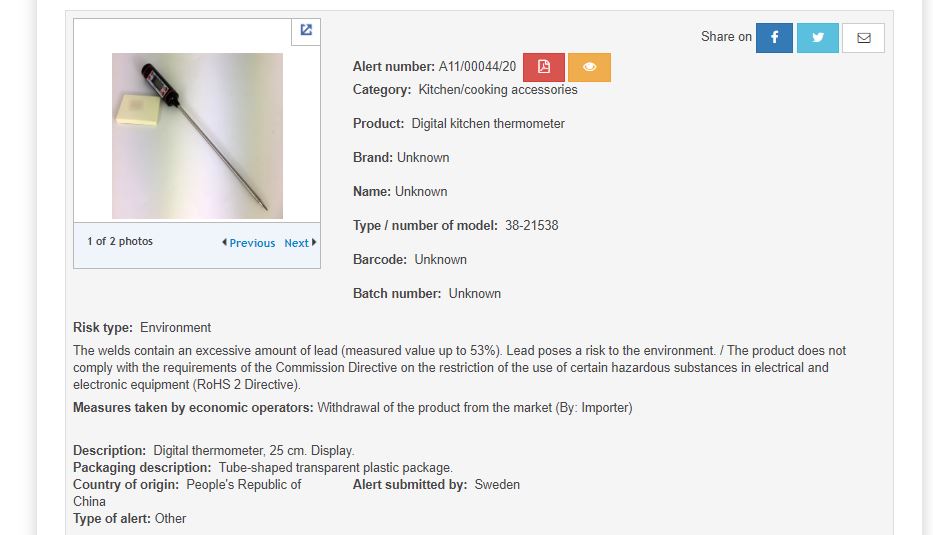
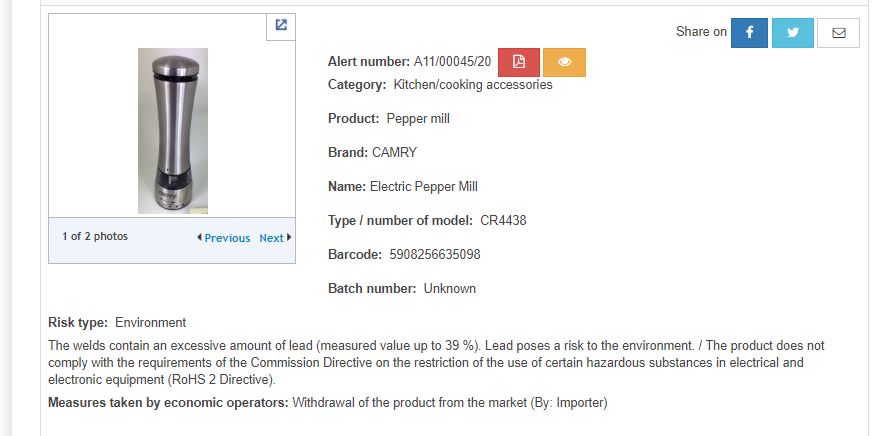
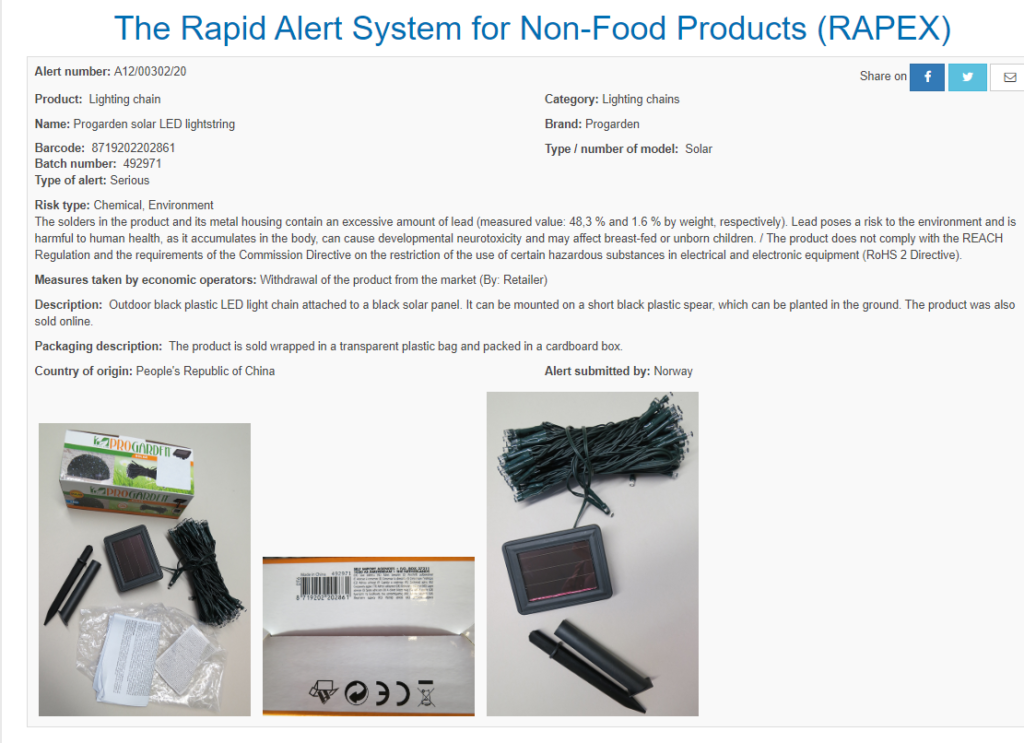
Today I opened the link in my email and reviewed a couple of products that were stopped for non-compliance to RoHS. See below.
Both of those images open to the corresponding alerts. I want to draw your attention to two things:
RoHS 2 is referenced. This means RoHS 2011/65/EU. Remember: that also means Commission Delegated Directive (EU)2015/863.
Both products were stopped because the welds contained excessive lead. They did not note that the whole product has a higher than acceptable level of lead: just the welds.
If I had to guess, based on my experience in handling RoHS compliance for F2 Labs customers since 2014, I would bet that the products did not claim any compliance to RoHS at all, or had a weak claim (no report to EN 50581:2012 to back it up).
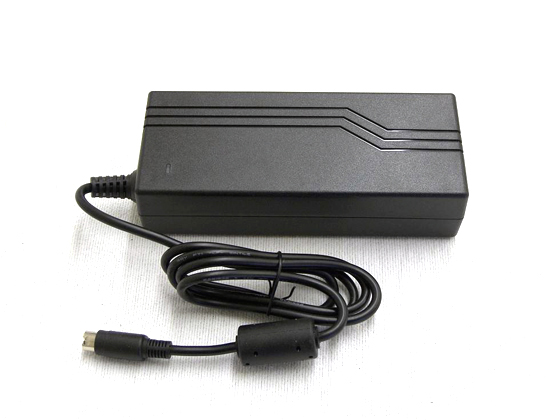
Is the picture at the bottom of this article what comes to mind when you think about RoHS? Don’t. We have handled hundreds of RoHS compliance projects for our customers. The first step we take is to determine if we can exclude it. (Yes, there are some exclusions!). We can help you too.
We can be contacted via this link. We can be reached by phone at 877-405-1580 and are here to help you.
If you are producing a product that can help with this crisis and you’re in need of assistance with regulatory approvals, advice, guidance or testing, we are here and want to do our part to help the country during this time of need.
In the wake of the Coronavirus, COVID-19, pandemic, we want you to know we care about you and we hope that you, your colleagues, family members, and friends are healthy and safe.
F2 Labs is taking all precautions to keep our employees and customers safe and we are open for business. We are fully committed to being here when our customers need us.
Our staff is continuing to focus on providing the highest level of customer service.
We can be contacted via this link. We can be reached by phone at 877-405-1580 and are here to help you. F2 Labs is here to help.
Posted inCE marking|Comments Off on NOTICE: We are offering PRO-BONO services – Can we help you?
The question in the title of this blog article is frequently asked by our customers.
Let’s break it down.
See the LVD 2014/35/EU, Article 1, para 2:
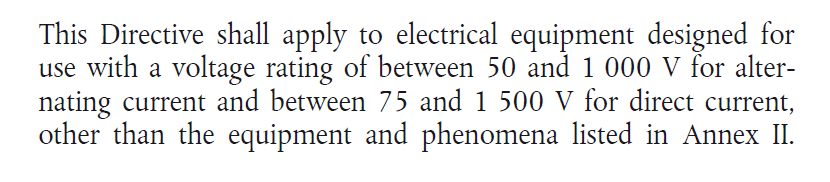
The Low Voltage Directive 2014/35/EU applies to products with a power input of 50 to 1,000 VAC and to products with a power input of 75 to 1,500 VDC. So, a product with a port for a mini-USB or a USB cable runs or charges from a 5 VDC input. It is excluded, right?
Maybe. Maybe not.
There are some distinctions. Technically, if you supply your small toothpick dispenser (my favorite widget example) to the EU…
and it only has a port for USB and that port is labeled “5 VDC”…
and your manual says that it requires 5 VDC…
and there is no mention of any connection to AC mains power (plugging into the wall) then your product is excluded from the Low Voltage Directive 2014/35/EU.
The EU authorities can and will look at your marketing literature, the packaging, the manual, and your website. They can say that your product is AC mains powered (in the EU that would be 220-230 VAC) if they see anything that shows your product plugged into the wall.
Let’s face it: a USB port on your product means that someone will likely take that product and connect a USB cable to it and then to a USB wall charger. Like the kind that come with every iPhone. In that case it is AC mains powered.
Here are some rules of thumb:
Supplying a charger or AC/DC power supply with your product makes it instantly in the scope of the Low Voltage Directive.
Specifying a connection to an AC/DC power supply for use with your product makes it instantly in the scope of the Low Voltage Directive.
A marketing picture showing this product connected to a wall charger makes it instantly in the scope of the Low Voltage Directive.
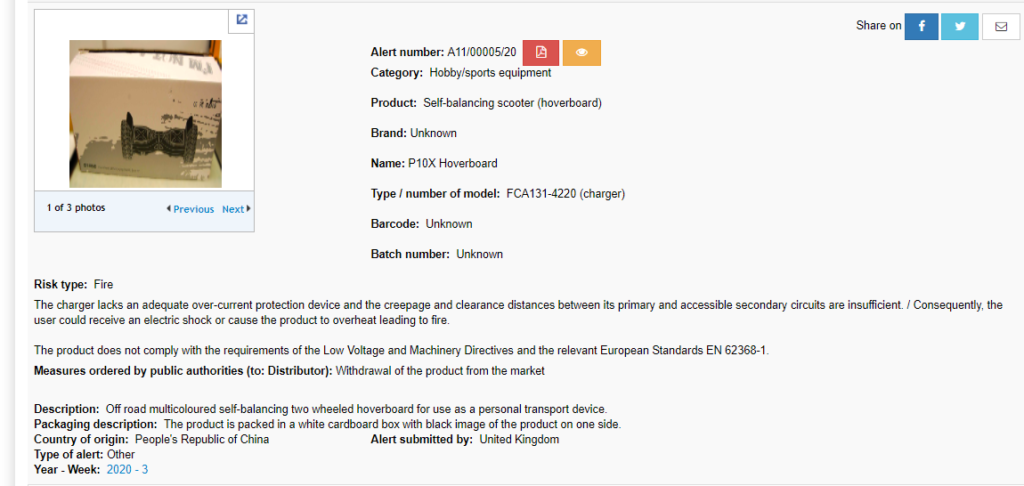
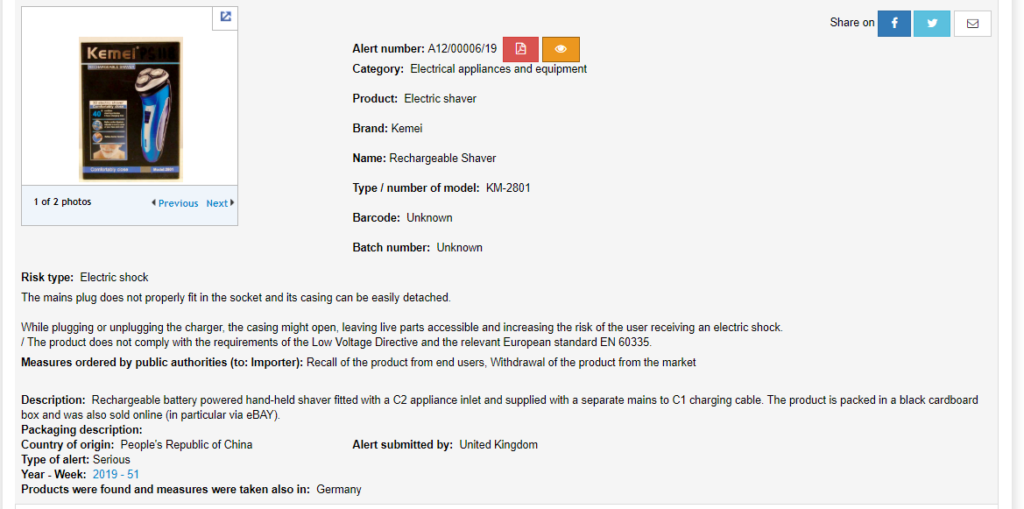
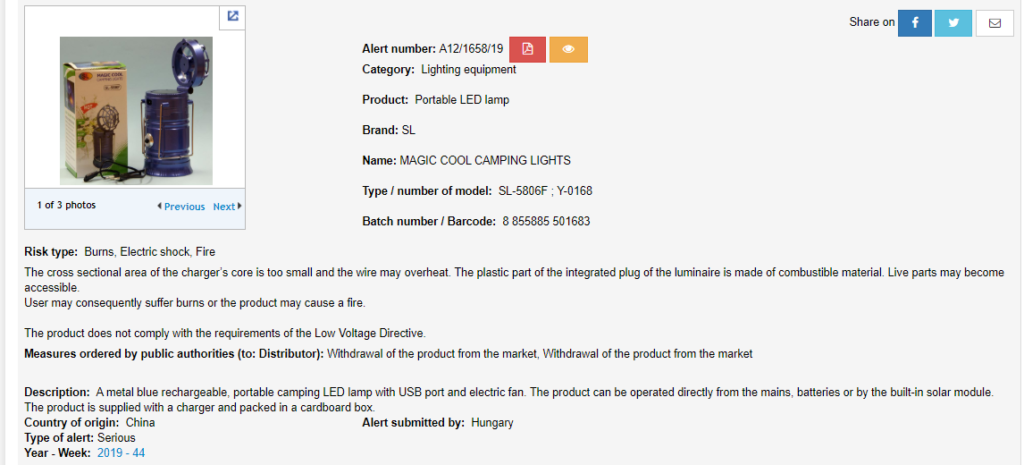
I often refer to the EU’s RAPEX weekly reports in this blog because it is a very useful tool to understand why products are stopped in customs and / or pulled from shelves. Below are some examples that illustrate the above. Clicking the pictures takes you to the individual alerts with more detail.
Below is a hover-board. Clearly not intended to operate while plugged in and charging.
.
Next up is a rechargeable electric razor.
Below is a rechargeable LED light for use while camping.
And below is a final example. Keep in mind that I searched “electric shock” as the risk on the RAPEX page and only for 2020 and 2019. There were more than 30 pages (with multiple entries per page) and I only went through the first few pages.
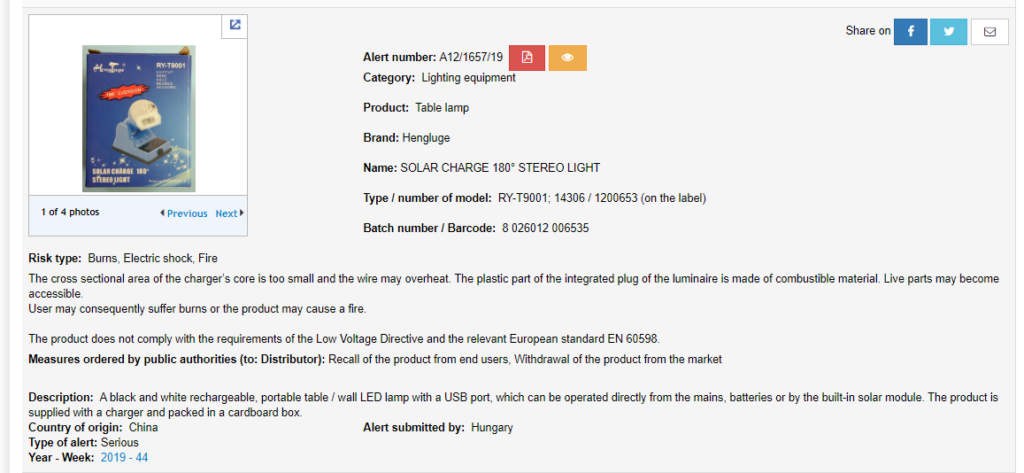
This final example is a solar powered light.
Notice that this light is supplied with a USB port and the authorities indicate non-compliance with the Low Voltage Directive and the following in the alert: A black and white rechargeable, portable table / wall LED lamp with a USB port, which can be operated directly from the mains, batteries or by the built-in solar module. The product is supplied with a charger and packed in a cardboard box.
The sales and engineering staff at F2 Labs study these issues every day. Call us. We can help you take an educated compliance path for your product.
We can be contacted via this link. We can be reached by phone at 877-405-1580 and are here to help you.
I get an email from RAPEX every Friday morning that details products stopped in customs in the EU for various issues. These are not all of the of the products stopped, just the most dangerous ones. RAPEX is an acronym for Rapid Alert System for dangerous non-food products.
Last Friday, February 28, 2020 I opened the email in the morning, which sent me to this link, and started scrolling like I do every week. I immediately noted that there appeared to be a larger than normal number of products stopped for non-compliance to RoHS 2011/65/EU.
This link is one example of a product stopped for RoHS non-conformity: Link.
The RAPEX email and alert is meant to tell everyone in receipt that the subject products are dangerous and should be removed from use immediately. Of course you do not want to end up in one of these alerts!
F2 Labs offers RoHS evaluations for EU (CE marking) compliance. We make these evaluations based on a study of your supplied bill of materials. No testing for RoHS is required in most cases.
We can be contacted at this link. We can be reached by phone at 877-405-1580 and are here to help you.
Most of our customers must comply with the EMC Directive 2014/30/EU prior to application of a CE marking to their products. This is because the EMC Directive is applicable to almost everything with active electronics. Unlike North American EMC compliance (FCC and ICES) which requires emissions compliance only, EU compliance to the EMC Directive requires emissions and immunity testing.
Proving this means testing to one or a pair of harmonized EMC EN standards. These harmonized standards indicate the required tests – which are usually contained in other standards we call, believe it or not, “test standards”. The most frequently used EMC test standards are below.
EN 61000-4-2 – ESD Immunity
EN 610004-3 – Radiated Immunity
EN 61000-4-4 – EFT Immunity
EN 61000-4-5 – Surge Immunity
EN 61000-4-6 – Conducted Immunity
EN 61000-4-8 – Magnetic Fields Immunity
EN 61000-4-11 – Voltage Dips/Interrupts
EN 55011 – Radiated and Conducted Emissions
EN 61000-3-2 – Harmonic Current Emissions
EN 61000-3-3 Flicker/Voltage Fluctuations Emissions
Now we come to the purpose of this article: power supplies and the problems that can be created if you select one that has not passed the same testing that you are submitting your product to now. We frequently see documentation for power supplies that does not prove compliance. Power supplies can cause emission issues which can be a source of EMC testing failures. And non-compliant power supplies cause these issues and other issues more than compliant power supplies.
The documentation for a power supply may look like the product is compliant but a little investigative work often shows that it is not. Anyone can place a CE marking on a product. Actually complying with the requirements is different. We suggest asking for the test report from the manufacturer or at least a certificate of test. If you are going to send your product to the EU then you should be asking for EU declarations of conformity for all major subassemblies and assemblies while your are spec’ing the build. A company that spends the time and effort to ensure valid CE marking is not going to hide the documentation that proves it. Just ask. Usually you will get it within an hour. If you do not get a requested EU declaration of conformity within 24 hours it is likley you will never get it. Because it does not exist.
We have seen many reports that were generated by a manufacturer internally. In the world of compliance these are not valid. Why? The testing lab must have laboratory accreditation to issue an actual TRF test report, the gear used to test the products must be continually calibrated, strict environmental parameters must be maintained, etc. The gear used for testing and the calibration dates for that equipment must be listed in the report. For some reports – information about the credentials of the testing engineer is required. The testing standard must also be listed in the report. Manufacturers are usually not internally-equipped to efficiently handle this.
Our sales department can discuss these issues with you. In fact, our salespeople look at these documents so frequently that we can often immediately tell you if a test report or declaration of conformity appears valid.
I hope this helps. Please contact us today with any questions or to discuss your project.
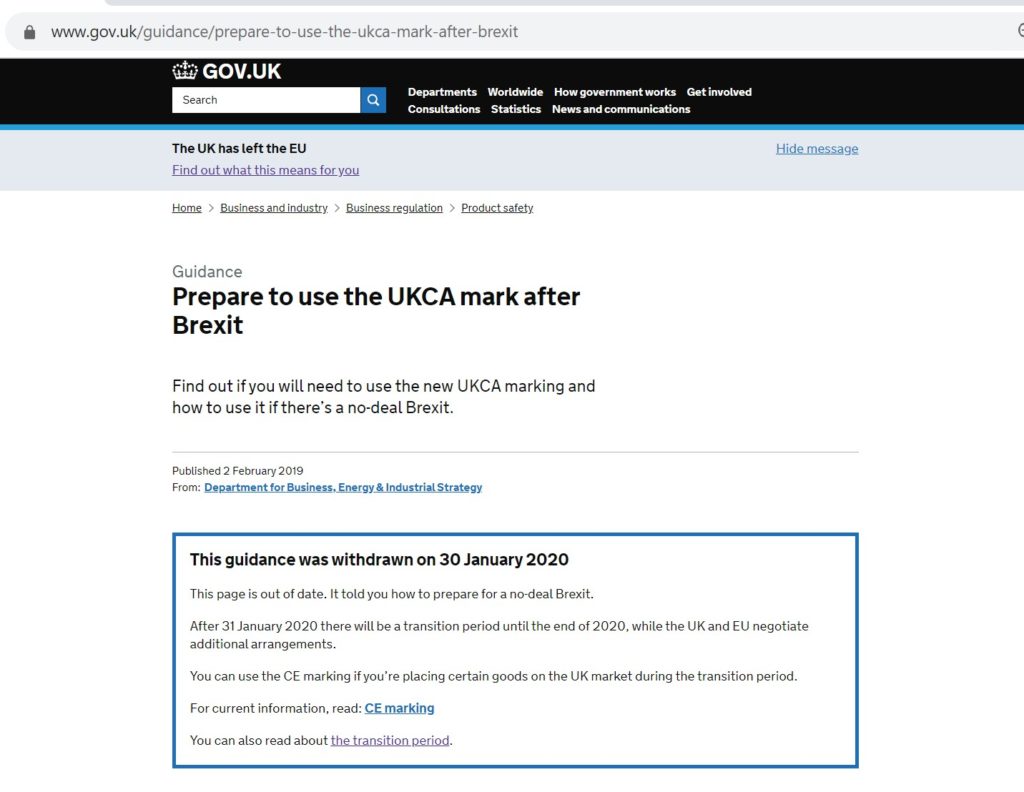
Yes, for now. CE marking will be accepted until at least the end of 2020 and then the UKCA mark will be the replacement mark for products sent to the UK. The link to the official UK page regarding this new information is here.
We can be contacted via this link. We can be reached by phone at 877-405-1580 and are here to help you.
However, I found it very notable that the company has been fined in the UK for price fixing. This does not involve any sort of engineering compliance issue, but it does show the international reach of market surveillance authorities. These UK authorities determined that Fender employees intentionally did not write things down about this. Presumably (my assumption) is that these employees were concerned about subpoenas for emails.
The CMA (Competition for markets authority) uncovered this during the investigation. I find this worthy of posting to our blog because it is just as important – or maybe more important – to make sure your CE marking compliance issues are taken care of, correctly.
We are separated from the EU by an ocean but it is our continuing responsibility to ensure products placed on the market in the EU are compliant and safe.
We can be contacted via this link. We can be reached by phone at 877-405-1580 and are here to help you.
Complying with any EU CE marking Directive will require a trip to one of many European Commission websites to assist with the process. They are great sources of information, I have them bookmarked, and one or more are open on my computer usually during the day.
Clicking that link will take you to a lot of good information.
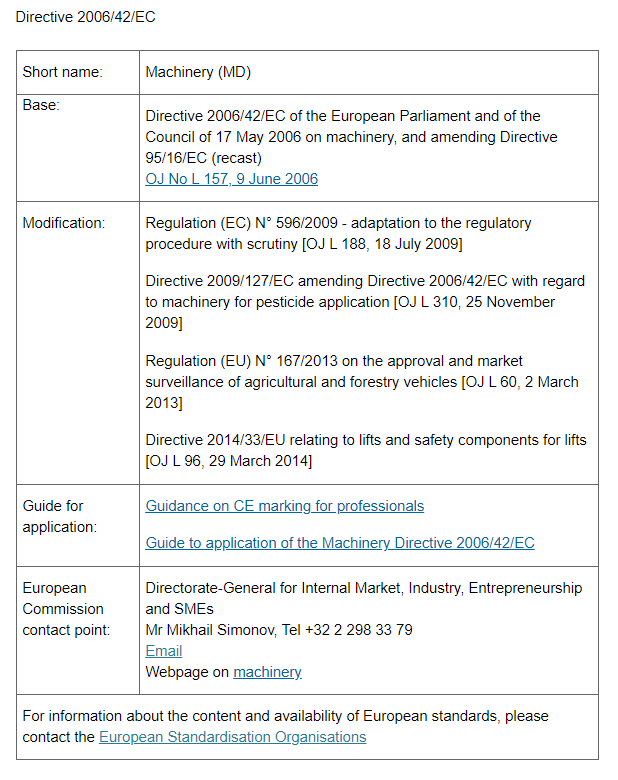
The first thing you will see on the page is this chart:
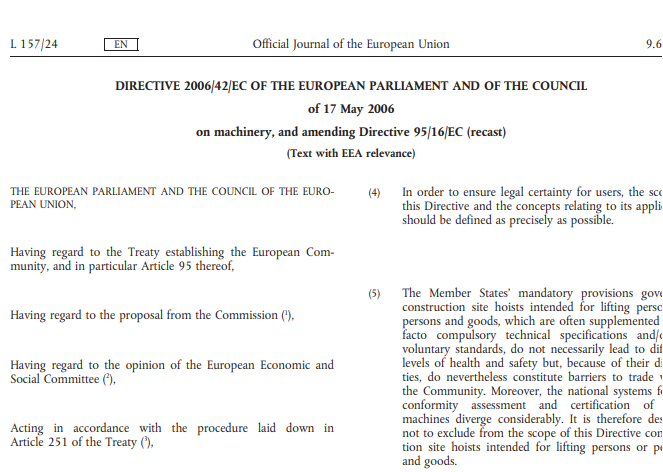
There are two very important links in that chart. The label “OL No L 157, 9 June 2006” is a link to the Machinery Directive 2006/42/EC. Open that link and you will see the text of the Directive but also this:
English is my first language, so I scroll over to the “EN” and then click the pdf symbol below it. That opens a pdf version of the Machinery Directive in English, here. It opens as displayed below.
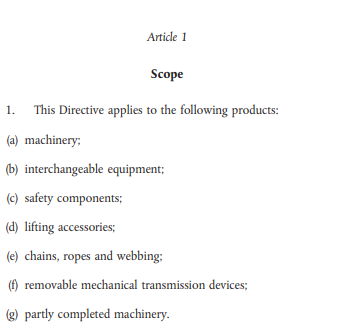
Are you new to CE marking and the Machinery Directive? I tell every F2 Labs customer the following, “Skip the recitals and go straight to Article 1. It’s all in plain English.” See below.
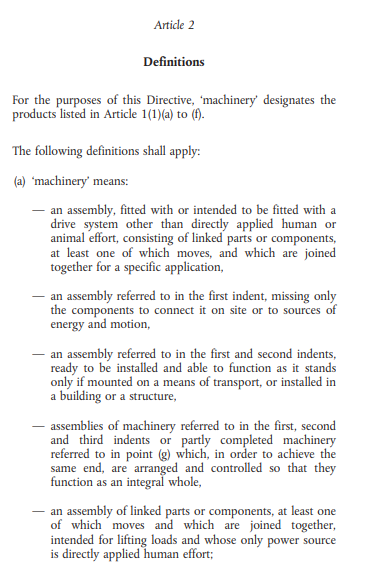
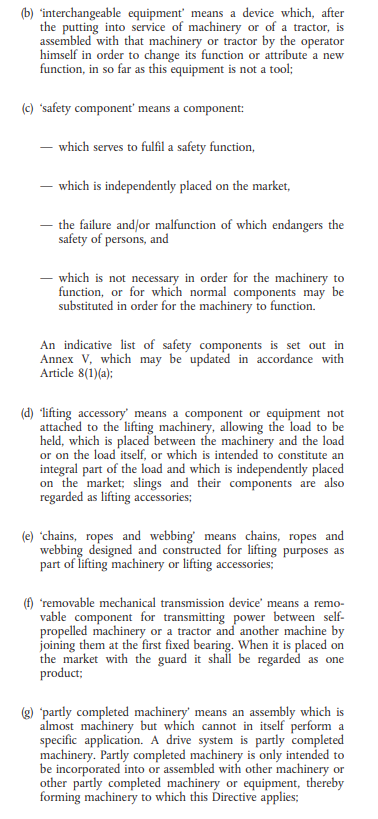
Next, go to Article 2 to see that everything in Article 1 has an easy-to-read definition.
The second very useful item in the chart from the top of this article is this:
I suggest clicking the link for the Guide to application of the Machinery Directive 2006/42/EC and saving it somewhere that is easy to get to. Because if you make machinery and you export to the EU you may learn that it is an invaluable tool that can be constantly referenced and learned from.
Lastly, are the links to the Official Journal of the EU lists of harmonized EN standards on the EC Machinery Directive page . These are very important because only harmonized standards offer the presumption of conformity for your machinery.
Side note: What does this mean? It means that if you are complying with the Machinery Directive and you use the appropriate and applicable harmonized EN standards (harmonized means the standard is officially “linked” to the corresponding Directive) to evaluate and test – and it passes – then your equipment has the presumption of conformity. The authorities or anyone else looking at the equipment should assume it complies with the reference legislation when reviewing your EU declaration of conformity if you used harmonized EN standards.
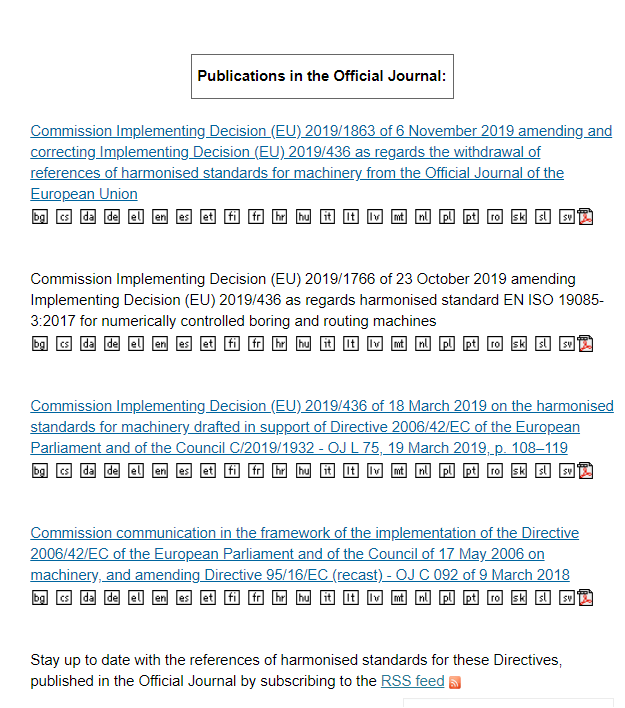
Now, we turn our attention back to the Machinery Directive page we began with. See three long links:
Those links are all important but they are all different. Choose wisely!
(EU) 2019/863 lists a number of standards that are withdrawn as harmonized standards from the Machinery Directive. The associated dates next to each standard tell you when you can no longer indicate these standards on your declaration of conformity if they are applicable to your equipment now. You will have to find a different set of standards to test/evaluate. This document was published this month (November 2019) to address some ambiguities and mistakes made in the second link ((EU) 2019/436). One notable mistake is that (EU) 2019/436 calls for the withdrawal of EN ISO 12100:2010. We wrote about that, here, because it was a major development.
Another correction to (EU) 2019/436 is that it lists standards to be withdrawn but does not indicate the date at which they (the indicated, withdrawn standards) no longer confer a presumption of conformity (i.e., the date you can no longer use them to prove compliance to the Machinery Directive).
Annex I – applicable new or amended harmonized EN standards
Annex II – harmonized EN standards that now have restrictions
Annex III harmonized EN standards to be withdrawn (but no date for withdrawal, see (EU) 2019/863)
Finally, we arrive at the current “list” of harmonized EN standards for the Machinery Directive in the last link:
That link takes you to the current list that is published in the Official Journal of the EU, or “OJ” as it is often referred.
At this time, for any new CE projects, we suggest that all three links must be consulted if you are determining which EN standards are applicable to your equipment. Or, contact us at F2 Labs. We can help sort it out.
We can be contacted via this link. We can be reached by phone at 877-405-1580 and are here to help you.
We are starting to feel some effects of the upcoming replacement of EN 60950-1 by EN 62368-1. This is causing some confusion in the compliance world as well and we wanted to share a recent example that we were contacted about.
The customer builds equipment that is a combination of three subassemblies that are themselves independently operational and must themselves carry a CE marking. These devices, when combined, create a new device which itself must carry its own CE marking.
This customer engaged F2 Labs after working with another lab. He contacted us because the other lab refused to accept that one of the assemblies was tested to EN 60950-1. The lab indicated that the assembly must be tested to EN 62368-1 to be acceptable because EN 60950-1 is expired.
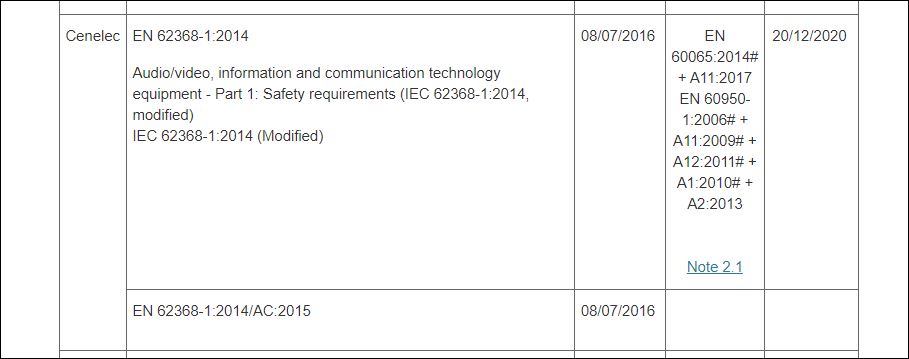
Upon reading the email from our customer I next opened the link to the Official Journal of the EU’s list of harmonized EN standards for the Low Voltage Directive 2014/35/EU, here. Next, I searched for EN 60950-1 and it appeared in the chart next to EN 62368-1. See below.
We have written about this topic before, here. And there is another article on our blog that goes into this topic in much greater detail, here. EN 60950-1 is formally expiring on December 20, 2020 and at that time you will no longer be able to send equipment to Europe if it has only been tested to that standard. You will need to have the equipment tested to EN 62368-1 so that you have a technical report from an accredited lab in your Technical File.
It’s also helpful to read the “Note 2.1” that is in the bottom of the grid square that lists EN 60950-1. See below.
Our advice is that if you have a product to send now and it was tested to the current version of EN 60950-1 then you can do it… but be wary of the date. You might get questioned about it (by your EU customer or maybe even in customs) and it is probably a good idea to schedule testing to EN 62368-1, soon, if you are making and selling your product to the EU over and over. We expect a lot of last minute EN 62368-1 projects in Q3 and Q4 of 2020.
Have a question or a comment? We can be contacted via this link. We can be reached by phone at 877-405-1580 and are here to help you.